Vol. 5 No. 1 (2025): Architectural Research Journal
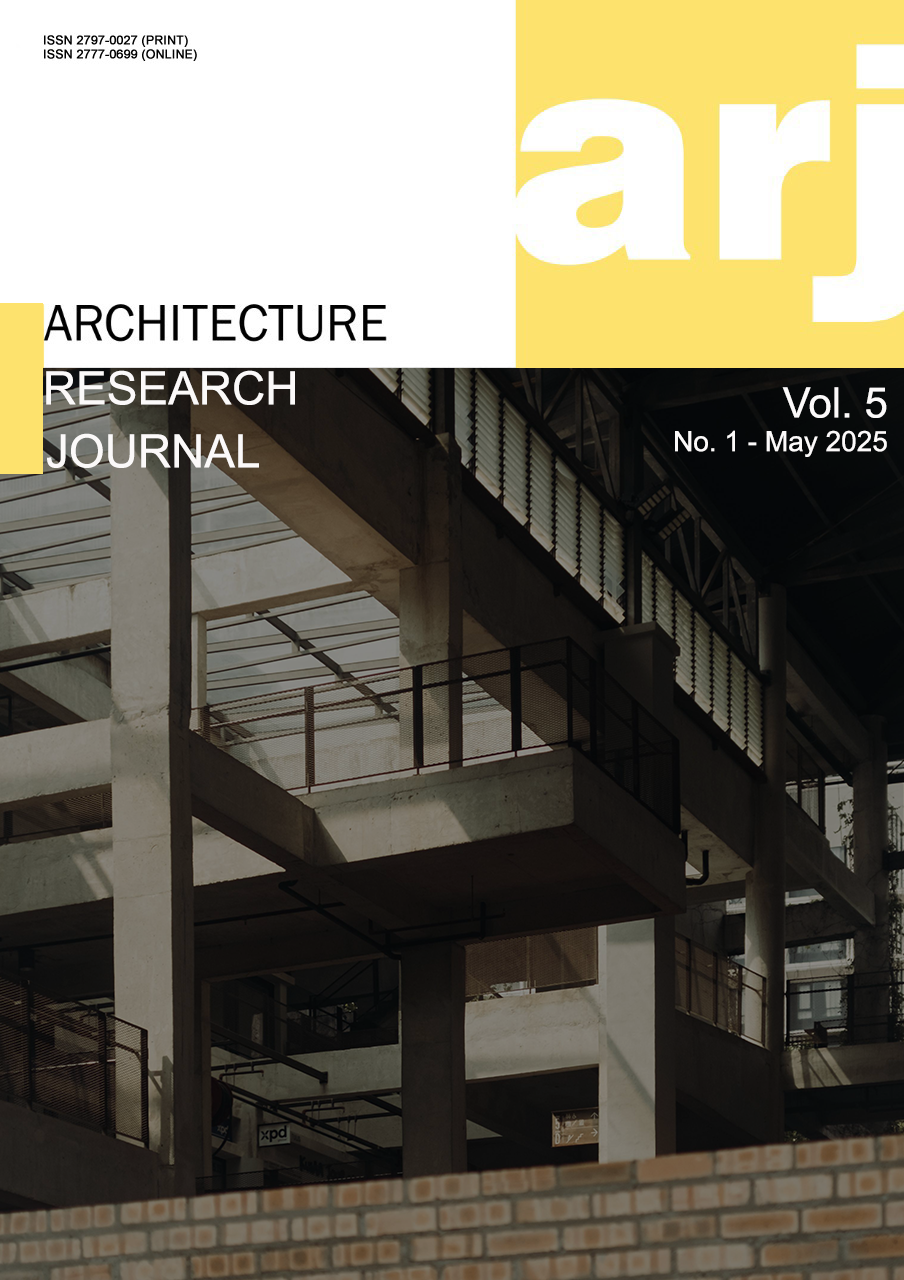
Architectural Research Journal (ARJ), Volume 5, Issue 1 (2025), brings together a collection of five research articles contributed by scholars from Universitas Muhammadiyah Jakarta, Universitas Widya Mataram, Universitas Faletehan, and Universitas Udayana. This issue reflects the journal’s commitment to advancing critical discourse on architecture through studies that bridge historical heritage, cultural sustainability, contemporary urban design, and inclusive spatial planning.
The contributions address a wide spectrum of architectural inquiries. The first examines the typomorphology of five historic mosques in Jakarta, Angke, Al Arif, Ansor, Kampung Bandan, and Luar Batang revealing distinctive spatial configurations shaped by vernacular, colonial, and Islamic traditions, and offering conservation insights sensitive to local identity. The second investigates the form and façade of the SQ Residence mixed-use office complex in Jakarta, demonstrating how contemporary architectural principles can merge geometric innovation with urban and environmental responsiveness. The third explores the evolving architecture of bale banjar in Kuta, Bali, under the influence of tourism, highlighting both the opportunities for cultural preservation and the risks of commercialization. The fourth evaluates the application of universal architectural principles in the redesign of Marsudi Putra 2 Pandak Special School, proposing solutions to improve accessibility, comfort, and inclusivity for students with special needs. The final article assesses the cultural and tourism potential of Yeh Gangga Temple in Perean Village, Tabanan Regency, identifying its unique Hindu-Buddhist syncretic heritage as an underutilized asset in Bali’s cultural landscape.
Together, these articles illustrate the breadth of contemporary architectural research in Indonesia, addressing challenges and opportunities across urban, rural, historical, and educational contexts. By combining theoretical analysis with field-based inquiry, the works in this volume contribute to the advancement of knowledge that supports sustainable development, heritage preservation, and innovative design practices.
Published:
2025-05-29