
Archives
-
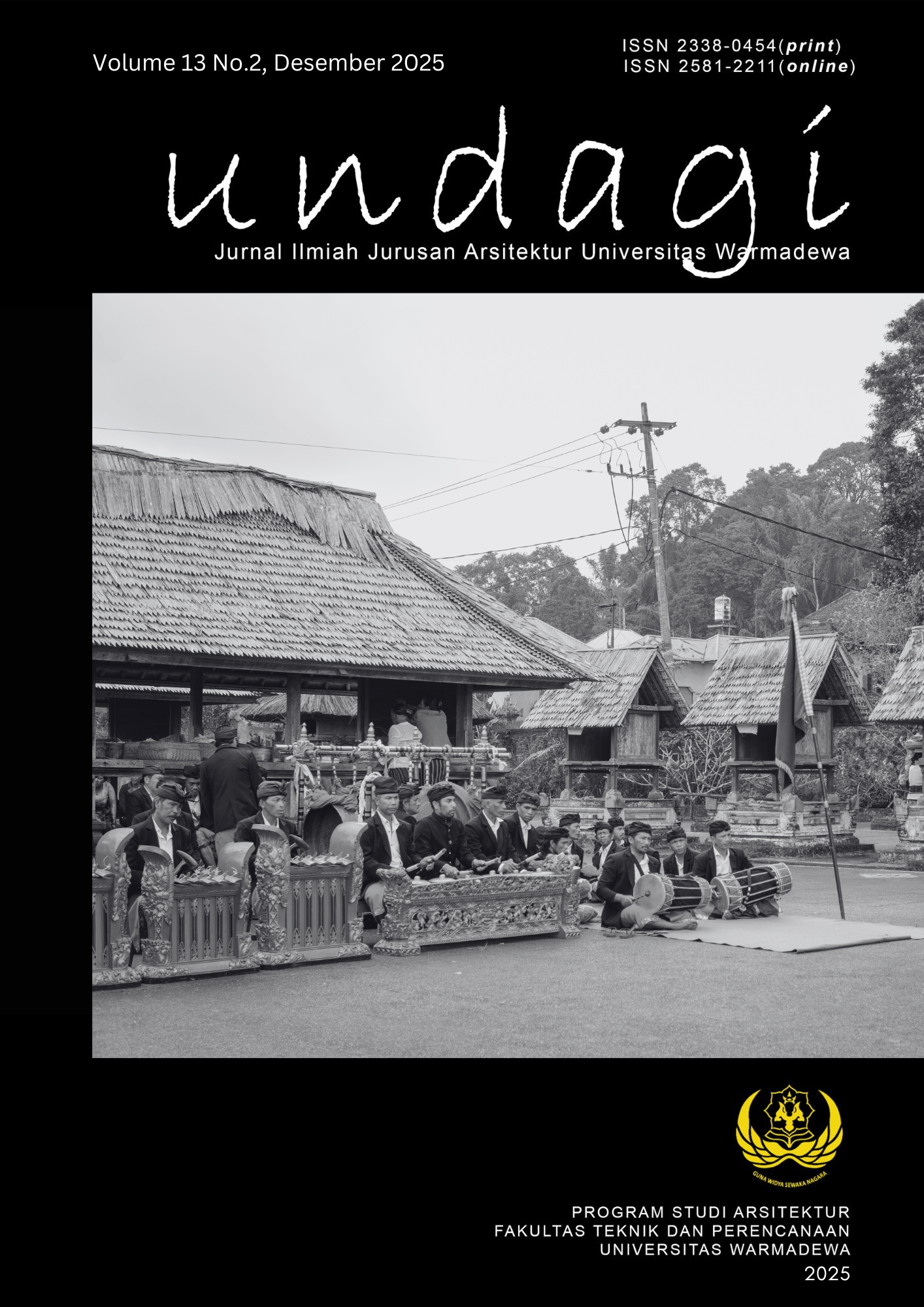
SettingsVol. 13 No. 2 (2025): UNDAGI : Jurnal Ilmiah Jurusan Arsitektur Universitas Warmadewa (Desember 2025)
Vol. 13 No. 2 (2025)Overall, the studies presented in this collection of articles demonstrate that architectural planning and design approaches play a strategic role in addressing social, cultural, environmental, and economic challenges across various regional contexts in Indonesia, particularly in Bali and its surrounding areas. The application of sustainability concepts—such as eco-architecture, green architecture, biophilic design, disaster mitigation, and community- and culture-based approaches—has proven effective in producing designs that are not only functional but also adaptive and context-responsive.
Each design emphasizes the importance of integrating user needs, natural environmental characteristics, and local wisdom as fundamental elements in the formation of architectural space. Public, tourism, educational, residential, and cultural facilities are designed by considering comfort, safety, inclusivity, and long-term sustainability. This approach encourages the creation of spaces that support social activities, cultural preservation, improved quality of life, and the strengthening of regional identity.
Overall, the planning and design outcomes presented in these articles provide both conceptual and practical contributions to the development of sustainable architecture in tropical regions. The findings and design concepts are expected to serve as valuable references for academics, planners, and architectural practitioners in formulating design solutions that are responsive to present and future challenges while maintaining cultural values and environmental balance.
-
Juni 2019
Vol. 7 No. 1 (2019) -
Desember 2018
Vol. 6 No. 2 (2018) -
Juni, 2018
Vol. 6 No. 1 (2018) -
Desember, 2017
Vol. 5 No. 2 (2017)




_032.jpg)
_033.jpg)
